By clicking “Accept”, you agree to the storing of cookies on your device to enhance site navigation, analyse site usage, and assist in our marketing efforts. View our Privacy Policy for more information.
Hosted at Workshop 17 in Newlands on 14 November 2025, the YOUKNOW team is joining forces with Welcome Tomorrow, Amplitude, OneSignal, AppsFlyer, and MMA South Africa for a day of app growth insights, real talk, and, yes, good coffee.
This time, the spotlight is on the shift every brand is feeling, moving from user acquisition to loyalty. Because while downloads look good on a dashboard, real growth happens when customers stick around.
The topic: Why businesses shift from acquisition to loyalty.
The discussion will unpack how retention is becoming the new acquisition, what “loyalty” really means in 2025, and how brands can use technology and empathy to build lasting connections.
Expect debates on everything from predictive analytics and personalisation to the “nice thing factor”, those small, human touches that make customers feel seen, not sold to.
The Bigger Picture: Building Habit-Forming Products
The panel is part of a wider AGSA agenda focused on activation, retention, and growth. Speakers from Amplitude, AppsFlyer, and YOUKNOW will explore the mechanics of stickiness, what keeps users engaged after that first “Aha!” moment.
From Welcome Tomorrow’s keynote on the hidden truth behind user acquisition, to YOUKNOW COO Don Packett’s session Highway to the Habit Zone, the day is designed for practical insights, not pitch decks.
Why This Conversation Matters for South Africa
In a market where customer expectations are high and competition is fierce, retention is not just a marketing metric, it is a survival strategy.
As one of the panel’s core questions explores: How do you use predictive analytics to identify customers at risk before they walk away? The answer lies in collaboration between data, creativity, and heart, exactly what this line-up brings to the table.
For South African brands, loyalty is not built through points or discounts. It is earned through relevance, reliability, and relationship, all things that start with understanding your audience.
Join the Conversation
If you are attending AGSA, make sure you do not miss this panel at 11:30 AM. Expect fresh perspectives, honest reflections, and a reminder that real loyalty is built between people, not platforms.
For updates and event highlights, follow YOUKNOW Technologies on LinkedIn, and stay tuned for post-event insights from the day.
Fintech is not the future anymore. It is here, reshaping how South Africans bank, invest, and pay. From mobile-first payments to buy-now-pay-later products, the competition for consumer attention is fierce. For banks, the challenge is clear: you cannot afford to wait for quarterly reports or outdated customer surveys. To compete with agile fintech disruptors, you need real-time consumer insights.
Why Real-Time Matters
South African consumers are moving faster than traditional banking systems. According to GWI, 73 percent of South Africans now use mobile banking weekly, while nearly half of Gen Zs and Millennials expect instant resolution to queries online.
If banks are not capturing this behaviour as it happens, they are already a step behind. Real-time insight means knowing:
When fraud signals start trending on social media.
Which products customers are praising (or abandoning) in comments and reviews.
How sentiment shifts when you change fees, policies, or digital interfaces.
It is the difference between reacting late and leading early.
Most traditional banks rely on lagging indicators: NPS surveys, call centre escalations, or campaign reports. By the time an issue surfaces, the damage is already done.
This creates three blind spots:
Fraud and Risk Signals: Phishing attempts and debit order scams often appear first in consumer chatter online.
Product Experience Gaps: Customers post frustrations on X or HelloPeter long before they escalate complaints formally.
Missed Opportunities: Positive moments, such as new feature adoption, are often lost in the noise without structured monitoring.
How Real-Time Insights Drive Fintech-Grade Agility
To operate at fintech speed, banks need to adopt the same playbook:
Always-On Listening: Tools like Brandwatch give banks access to billions of real-time data points across social, forums, and review sites.
Contextual AI: Sentiment analysis detects frustration, delight, or sarcasm in multiple South African languages, turning raw data into usable intelligence.
Dashboards That Talk to Strategy: Live dashboards link consumer behaviour to KPIs such as churn risk, campaign performance, or product uptake.
With these capabilities, banks are no longer chasing the conversation, they are shaping it.
Local Insight, Local Advantage
The South African financial market has unique signals. Township economies, stokvel communities, and budget-conscious consumers create patterns global banks might miss. Real-time insights give banks the ability to:
Spot geographic hotspots of fraud activity before it escalates.
Detect how fee sensitivity drives loyalty shifts among lower-income groups.
Understand cultural nuances in slang and sentiment that affect perception.
At the end of the day, fintechs thrive on speed, but banks still hold the edge in trust — if they manage it right. McKinsey’s 2025 report showed that South African consumers are 2.5 times more likely to remain loyal to financial institutions that act transparently during crises.
Real-time consumer insight is the bridge between fintech agility and banking trust. It helps banks move faster, speak clearer, and act before customers lose faith.
Your Next Step
The future of banking will not wait. If you are relying on old data, you are already falling behind. With the right tools and partners, South African banks can use real-time insights to match fintech speed while reinforcing trust.
Book a consultation with YOUKNOW to see how we help banks unlock fintech-grade agility.
South Africa woke up to insights over coffee and croissants as we hosted Brunch with Brandwatch, bringing global expertise to a local stage. Together with the Brandwatch team, who flew in from the United Kingdom to join us, we explored how consumer research and social listening can help decode today’s fast-changing behaviours.
From banking and retail to telecommunications and tourism, one theme cut across every conversation: the speed of culture has never been faster, and the brands that thrive are those who can hear the whispers before they become headlines.
The Ripple Effect of Influence
Our Chief Executive Officer, Kelvin Jonck, opened the day with a reminder that every shift in consumer behaviour begins with a spark.
Sometimes it is seismic: tariffs, boycotts, global conflicts. Sometimes it is small: a meme, a viral TikTok, a comment on Reddit. But the effect is always the same, ripples that spread across culture, shaping what people buy, believe, and expect.
Drawing on Malcolm Gladwell’s Tipping Point and a touch of Freakonomics, Kelvin framed the psychology of influence:
Recognise sparks with ripple potential.
Capitalise on trends before competitors do.
Guide conversations with authenticity.
It was the perfect set up for a day that moved from theory to practical application.
Insight-Driven Storytelling: Share of Heart
Alistair Wheate followed with a keynote on insight-driven storytelling. His challenge to the room: relevance is not about noise, it is about being seen, heard, and understood.
Through examples that ranged from toothpaste tariffs in Canada to the role of human truths in global campaigns, Alistair showed how insight can unlock “share of heart.” When brands listen deeply and stack those insights into powerful narratives, the results move beyond awareness to genuine emotional impact.
Key takeaways included:
Human truths drive the most powerful stories.
Relevance is about connection, not just reach.
Insight stacking can transform campaigns from tactical to cultural.
Masterclass: From Misinformation to Micro-Trends
The finale of the morning was Alistair’s masterclass on misinformation, artificial intelligence, and trend spotting.
Misinformation is no longer just a news problem; it is a brand problem. When trust erodes, every interaction is at risk. Social listening, however, offers a way through the noise.
Alistair’s session explored how artificial intelligence can enhance listening, where it falls short, and why human judgment still matters. Practical demonstrations showed how to:
Track journalists, creators, and forums with AI-powered dashboards.
Detect weak signals early and convert them into action.
Curate sources carefully to avoid “garbage in, garbage out.”
Treat AI not just as a tool, but as an audience in its own right.
The message was clear: insights are only as strong as the sources they are built on. Pair the speed of AI with human scepticism, and you unlock smarter, safer decisions.
Wrapping Up: Where Do We Go From Here?
The morning made one thing clear. Influence and information will only get faster, noisier, and more fragmented. The teams that succeed are those that can separate the signal from the noise, turn it into insight, and act quickly with credibility.
Brandwatch showed us the tools. The conversations in the room showed us the appetite. And the examples, from tariffs and toothpaste to memes and misinformation, proved that no brand is immune.
For South African marketers, analysts, and strategists, this is both a challenge and an opportunity. Listening is no longer a “nice to have”, it is the edge. Those who invest now will be better prepared not just to keep up, but to set the pace.
We are grateful to Alistair Wheate for flying in from the United Kingdom, and to the full Brandwatch team for making it practical, not theoretical. And of course, to everyone who joined us, thank you for bringing your questions, your scepticism, and your curiosity.
If you want to go deeper, check out our posted workshop notes or book a session with YOUKNOW to see how Brandwatch can help your team listen sharply, spot trends earlier, and act with confidence.
Social Media Trends 2025: What South African Brands Need to Know
Social media is evolving faster than most teams can keep up with, and chasing every new trend is not a strategy. According to Hootsuite’s 2025 Social Trends report, the brands seeing real results are not the ones copying viral dances or jumping on every meme. They are the ones who know their audiences, experiment with bold creative, and use AI to scale without losing authenticity.
For South African marketers, that shift matters. Our audiences are diverse, demanding, and digitally savvy. Whether it is retail, finance, or FMCG, the challenge is no longer simply being present online, it is about being meaningful.
Entertainment Is the New Engagement
Almost half of global marketers now say their social content is built primarily to entertain, educate, or inform. In South Africa, this shift is already obvious. TikTok and Reels have become default spaces for younger audiences, and brands that entertain are the ones being shared.
It is not just about humour either. Checkers’ Sixty60 pushes into culture with speed and creativity, while Nando’s continually reinvents its tone to stay sharp. These brands prove that when you move beyond rigid brand rules, you unlock more cultural relevance.
Outbound Engagement Builds Trust
The report shows that more than four in ten organisations are testing proactive engagement strategies. This means joining conversations in the comment sections of creators, not just waiting for your own page to light up.
For South African industries where trust is fragile, such as banking or insurance, this approach is gold. Instead of trying to buy attention with ads, being part of conversations where your audience already engages builds credibility.
Listening Powers ROI
For years, social media reporting stopped at likes and shares. Today, social listening tools are proving direct ROI by linking conversation data to sales, churn reduction, and product feedback.
In South Africa, this is particularly valuable in sectors with high competition. Banks can detect early complaints about app issues before they escalate, while telcos can track sentiment around service quality in real time. Social listening is not about vanity metrics, it is about protecting revenue and reputation.
AI Moves Into the Everyday
AI has officially gone mainstream. The report highlights that most marketing teams are now using AI to create more content than they could without it, but the real opportunity is not volume, it is scale.
For South African brands, AI makes it possible for smaller teams to perform like larger ones. It helps draft, edit, and analyse, but it cannot replace local context or cultural nuance. The winning formula will always be AI plus people, not AI instead of people.
The Takeaway
The 2025 trends point in one direction: audiences want more meaningful, authentic engagement. South African brands that combine bold creativity, proactive engagement, and sharp social listening will not just keep up, they will lead.
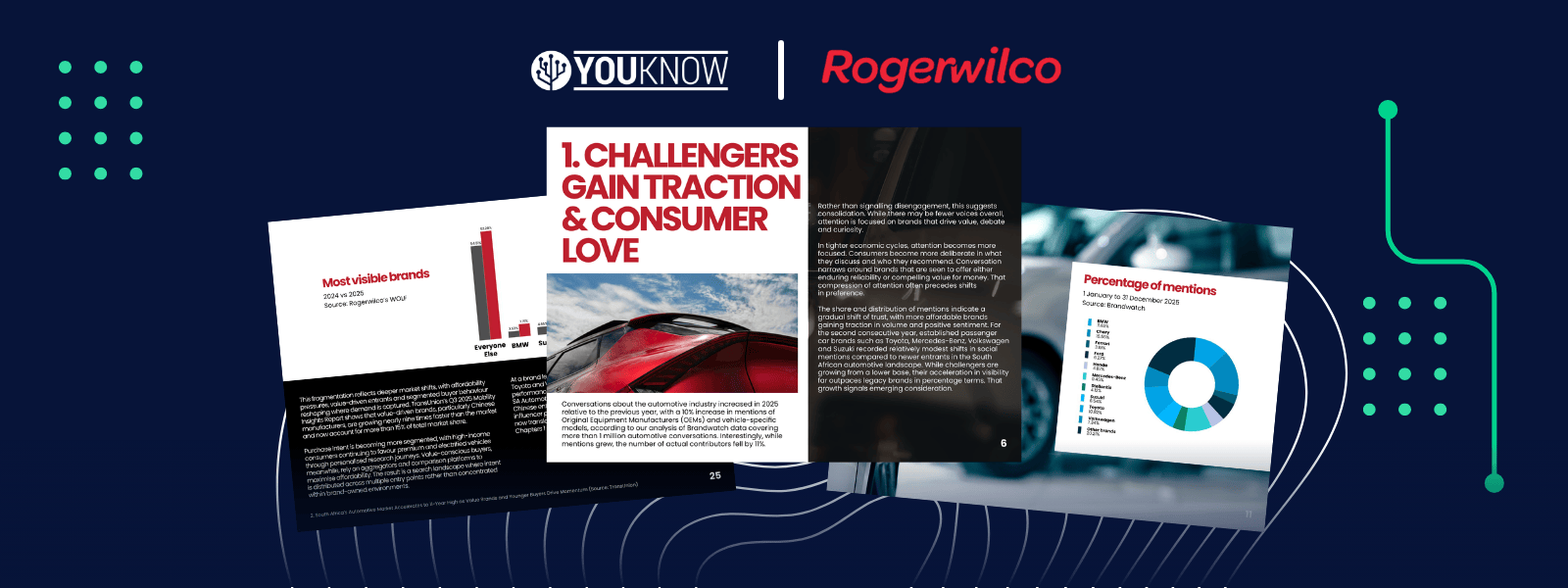
Car buyers in South Africa no longer begin their journey at a dealership forecourt. They begin online, searching Google, scrolling social feeds, and comparing brands in review forums long before a salesperson has a chance to engage.
The new Automotive Digital Trends Report, developed with Rogerwilco and MoyaApp, reveals how digital discovery and sentiment are shaping the industry. Download the full report.
The power of search signals
The report highlights how challenger brands are making gains not because they outspend the big players, but because they are easier to discover online. Search visibility at the “moment of intent” is now critical.
If a prospective buyer cannot find you when they’re comparing models or calculating finance, you have already fallen behind. This echoes lessons from Spotting Trends Before They Break, where timing often decides who leads and who plays catch-up.
Why sentiment still matters
Although listed mentions in the automotive space have slowed, expectations for service, safety, and reliability are higher than ever. A dip in sentiment can quickly chip away at trust.
This is why structured reporting is key. Tools like Brandwatch, underpinned by frameworks such as the [Social Data Audit Checklist], help brands detect whether conversations are shifting before it snowballs into a crisis. Combine this with approaches we covered in [Optimising CX with Social Insights] and you move from reacting to pre-empting.
The local lens
In South Africa, context is everything. Over 90% of automotive-related searches include “near me”, emphasising just how much proximity and convenience influence purchase decisions. Beyond national brand campaigns, it is often the dealership visible in a specific township or city that wins the sale.
This reinforces the need for hyper-local digital strategies, tailored messaging, and authentic service delivery that align with the South African reality.
The bottom line
If your marketing budget still leans heavily towards traditional media while competitors are investing in discoverability, you’re giving away an edge.
Winning in this market isn’t about shouting louder. It is about being visible when it matters, listening to what buyers are actually saying, and ensuring those insights shape pricing, stock, service, and creative strategies.
On Sunday 19 October 2025, thousands of runners were ready to take on the Cape Town Marathon. Hours before the start, strong winds forced organisers to cancel the event.
For runners, it was devastating. For organisers and sponsors, it was reputationally risky. And for marketers, it became a live case study in how one decision can dominate the national conversation.
Because while the race never ran, the conversation did.
The Conversation Surge
Mentions of the Cape Town Marathon jumped from just 127 the week before to 7,543 during the cancellation period. That is a 5,839% increase.
On the day of cancellation, conversation peaked at more than 6,000 mentions, driven by over 4,000 unique voices. Compared to 2024, where the event barely made a digital ripple, this was a seismic shift.
Volume Over Time (2020 - 2025) graph comparing 2024 and 2025 mentions of the Cape Town Marathon
For brands, this is the first lesson. Events can change course in an instant, and the conversation does not wait for your press release.
Sentiment Split: Not All Negative
The most striking insight was not the spike itself, but the balance of emotion.
45% negative: complaints about wasted money, travel, and preparation.
43% joy: relief and even gratitude that organisers put safety first.
13% anger: frustration at communication gaps and accountability concerns.
Sentiment Breakdown (13 Oct - 20 Oct 2025)
Emotion breakdown showing frustration and joy split (13 Oct - 20 Oct 2025)
This mix is uniquely South African. Consumers here can be outspoken and critical, but they are also pragmatic and quick to respect difficult decisions when they are made for the right reasons.
Who Was Talking
The conversation was not limited to athletes.
Journalists amplified the news with quick reporting.
Executives and professionals discussed accountability and business impact.
Artists, athletes, and communities shared personal stories.
Interests spanned sport, fitness, family, parenting, and business.
Top professions of overall mentions (13 Oct - 20 Oct 2025)
Top interests of overall mentions (13 Oct - 20 Oct 2025)
The Cape Town Marathon was no longer a sporting story. It became a national talking point that stretched across industries and households.
The Sponsor in the Spotlight
One of the most telling insights was that the two most mentioned words were “Cancelled” and “Sanlam.”
Mentions word cloud (13 Oct - 20 Oct 2025)
Although weather was the root cause, the sponsor was inevitably drawn into the conversation. Sanlam’s response, offering future race entries, softened some of the disappointment, but it also shows how easily a brand can become the centre of a crisis it did not cause.
For brands, this is the reality. You do not need to cause a crisis to become the face of it.
Why Monitoring Matters
This is where Brandwatch proves invaluable. Real-time monitoring gave us the ability to see:
When conversation spiked and why.
Which platforms were driving it (with X dominating, followed later by news and community forums).
How sentiment shifted hour by hour.
What emotions sat beneath the numbers.
Content Sources of overall mentions (13 Oct - 20 Oct 2025)
Deep Dive into X mentions (13 Oct - 20 Oct 2025)
Iris AI summary analysis of X mentions (13 Oct - 120 Oct 2025)
With tools like Brandwatch, brands can move from reacting late to acting with agility.
Why Post-Event Analysis Matters Even More
Once the crisis passes, analysis remains essential. It answers key questions:
Which issues continued after the peak?
Who was most vocal, and in which communities?
Did the brand response improve sentiment, or leave frustration unresolved?
What lessons can be applied to future planning?
This is the kind of insight our YOUKNOW reporting team specialises in. We provide bespoke reports, delivered quickly, that move beyond surface-level sentiment to show the real drivers of conversation and what they mean for future reputation.
Trending topics (13 Oct - 20 Oct 2025)
The South African Spirit
Amid the frustration, what stood out most was the resilience. Nearly half of the conversation praised the safety-first decision. And many runners still took to the streets on the day, supported by friends and family, to finish their own races.
That duality, outspoken criticism combined with pragmatic resilience, is what makes South African audiences unique. And it is why data is so important. Without it, the story looks one-dimensional. With it, the full picture becomes clear.
Final Word
The Cape Town Marathon 2025 did not run, but it gave us an invaluable lesson. Crises cannot always be prevented, but they can be managed. Brands that monitor in real time, listen to the nuance, and learn from post-event analysis stand a far better chance of protecting trust.
Our YOUKNOW reporting team, working with Brandwatch, helps brands do exactly that, producing fast, bespoke reports that cut through noise and reveal what audiences are truly saying. Because in South Africa, events may be cancelled, but the conversations around them never are.
The South African gaming and betting market has shifted dramatically in the past five years. Players are no longer sitting at desktop screens; they are on mobile devices, in WhatsApp groups, and on platforms like TikTok and Twitch, shaping the culture of play in real time.
If your engagement strategy is still focused only on traditional ads or email campaigns, you are missing the heart of where your players live, connect, and influence each other.
The South African Reality: Mobile First, Community Driven
According to ICASA, mobile penetration now exceeds 90 percent, with data bundles driving massive adoption of mobile-first behaviour. For betting and gaming brands, this means:
Short-form video (TikTok, Instagram Reels) is where trends are born.
Community chat apps like WhatsApp and Telegram are where strategies, tips, and results are shared.
Streaming platforms like Twitch and YouTube Gaming are where loyalty is built.
Generic campaigns will not cut it. To engage players, you need to speak their language and show up in their spaces.
Join, Don’t Interrupt Players are quick to dismiss out-of-touch ads. Instead, embed your brand in conversations they are already having. Example: sponsoring local esports tournaments or surfacing highlights from SA football on TikTok.
Community as a Channel In South Africa, WhatsApp groups are a central part of gaming and betting culture. With over 28 million active users, these closed communities often share information faster than traditional media. Brands that ignore them miss key sentiment and behaviour signals.
Reward Responsiveness Speed matters. If a player complains about slow cash-outs on Twitter, how quickly you respond determines not just their loyalty, but the public’s perception of your brand.
Engaging players is not just about more clicks and wagers. Regulators and communities expect brands to promote responsible gaming.
By using social listening, brands can:
Spot when players express frustration linked to harmful behaviour.
Redirect engagement towards safer play.
Build trust through visible care, not just marketing.
Local Flavour, Global Impact
South African players do not always follow global gaming trends. Township-based betting shops, football-driven loyalty, and even local slang (“multi-bet,” “gooi a slip”) create engagement rules that global platforms often miss.
Social listening allows you to track these unique cultural markers, helping you build campaigns that feel authentic rather than imported.
The Takeaway: Go Where the Players Are
Winning in South Africa’s fast-growing gaming and betting industry requires more than flashy odds and sponsorships. It demands a strategy rooted in where players actually spend their time — on their mobiles, in their chats, and in the conversations shaping their play.
With the right insights, your brand does not just join the game. It leads it.
In banking, compliance is often seen as a cost centre. A box to tick, a report to file, a process that slows down innovation. But what if compliance could be turned into a competitive advantage? In South Africa, where trust in financial institutions is tested daily by fraud, misinformation, and reputational crises, the way you manage compliance is not just regulation, it is reputation.
Social media is at the heart of this. Customers no longer wait in branches to raise concerns. They post on X, tag their bank on Facebook, or drop a comment on Instagram. The challenge for banks is that every one of these interactions is a compliance risk and a trust opportunity.
Why Compliance Cannot Be an Afterthought
According to SABRIC, digital banking fraud incidents increased by 24 percent in 2024, with phishing and SIM swaps among the most reported issues. At the same time, PwC research found that 70 percent of South African consumers are more likely to trust a bank that communicates transparently during incidents.
Compliance in social channels is no longer just about avoiding fines. It is about ensuring that every interaction builds confidence, that risks are detected early, and that reputational trust is protected before regulators or the media step in.
How Hootsuite Helps Banks Stay Ahead
Hootsuite is not just a publishing tool. For banks, it becomes a compliance safety net and a reputational shield. Here is how:
1. Audit Trails That Stand Up to Scrutiny
Every post, reply, and piece of content is logged with full audit trails. This means your compliance teams can instantly trace actions, approvals, and edits. No more frantic searches through spreadsheets when the regulator calls.
2. Approval Workflows That Prevent Risk
Hootsuite allows banks to set layered approval systems. Junior staff cannot publish without oversight, while senior teams can escalate sensitive queries. This reduces the risk of a rogue tweet or poorly timed response damaging the brand.
3. Real-Time Monitoring of Customer Conversations
Customer complaints on social channels are not just service issues. They are potential compliance triggers. Hootsuite integrates monitoring so teams can detect risk-related keywords like “fraud,” “scam,” or “unauthorised debit” and respond before issues escalate.
4. Archiving for Regulated Industries
In highly regulated environments, records must be stored securely. Hootsuite’s archiving ensures every social interaction can be retrieved, reviewed, and defended. This is essential for meeting POPIA and FSCA requirements.
Compliance as a Brand Builder
When customers see banks respond quickly and clearly, confidence grows. In fact, Deloitte reports that banks with advanced compliance-driven engagement are 30 percent more likely to retain customers during crises.
Compliance, then, is not a burden. It is proof that you take your customers seriously. A complaint resolved within regulatory guardrails becomes a story of reliability, and in South Africa’s competitive financial landscape, that is a differentiator.
Turning Compliance into a Competitive Edge
South African banks spend billions on compliance every year. But the winners are the ones who connect compliance with customer experience. With Hootsuite, compliance is not hidden in the back office, it is visible in the speed, accuracy, and empathy of your social engagement.
It becomes a way to:
Prove transparency when fraud or downtime hits.
Show accountability by having clear approval and monitoring systems.
Build trust by treating compliance not as a delay, but as a sign of integrity.
Your Next Step
If your compliance processes feel like red tape, it is time to rethink. With the right setup, compliance is not a constraint, it is a story of trust, safety, and leadership.
The R50 Dilemma: Why Chasing New Customers is Killing Your Long-Term Profit
Buying growth is easy. Compounding it requires discipline.
Last month, a Chief Marketing Officer (CMO) shared their quiet dilemma: "Do we pour more budget into acquisition or fix retention first?" With a crucial budget meeting just days away, their Customer Acquisition Cost (CAC) looked acceptable, but customer churn was a serious problem. They felt pressured to keep the top of the funnel full, even as the bottom was leaking profit.
Sound familiar?
This is the hidden crisis inside many growth strategies: we celebrate the immediate win of a first conversion but fatally under invest in what happens next. The only true scoreboard that reveals your business's health is Customer Lifetime Value (LTV).
What is an LTV Gap? And How Does it Undermine Your Marketing ROI?
We naturally gravitate towards metrics that are easy to buy (impressions, installs, first orders) while neglecting the ones that must be earned (repeat purchases, feature usage, expansion revenue, and loyalty). This focus on short-term metrics is why the CMO in our introduction was stuck.
The space between the easy wins and the earned value is your LTV Gap, and that is precisely where margin leaks. As the saying goes, marketers tend to value what's easily measurable rather than measuring what’s valuable. By only chasing easily measurable actions, we underinvest in the long-term customer experience, ultimately creating the profit leak that the LTV Gap represents.
Product-Led Growth and the LTV Solution
Adopting a Product-Led Growth (PLG) mindset helps close this gap. It's about shortening the time-to-first-value and consistently nudging customers to their next value moment, at the right time, on the right channel. LTV, therefore, is the metric that shows whether these subtle product and marketing 'nudges' are truly compounding your business value or diminishing it.
Same ROAS, Dramatically Different Profit: The LTV Calculation Breakdown
Here’s the thing about LTV: it isn't a single number in a static spreadsheet. It's a constantly moving result of how customers arrive, activate, return, expand, and ultimately stay.
To ensure your LTV metric is simple, trustworthy, and actionable, you must focus on the correct inputs:
Use cohorts, not blends: Compare customer groups based on when they joined or how they were acquired.
Use gross margin, not revenue: LTV must reflect profit after costs, not just top-line sales.
Pair LTV with CAC: The LTV:CAC ratio is the ultimate measure of unit economics.
Why You Don't Have Just One LTV Number
Crucially, your business doesn't have a single, unified LTV figure; you have many. By comparing your LTV by customer segment, based on factors like acquisition channel or in-product behaviour, you can identify your most valuable customers. This insight allows you to make smarter decisions about your marketing budget, ensuring you’re investing in customers who will truly compound your growth.
In the first scenario, your initial Return on Ad Spend (ROAS) looks great at 2.5x (R500/R200). However, the profit is only R50.
In the second scenario, by simply re-engaging customers via a low-cost channel like email, your total profit from that customer jumps to R540.
The Key Takeaway: Your repeat customers should carry little to no additional CAC. If you find yourself consistently paying a high cost (like R80 in the third scenario) to "reacquire" a customer through paid ads, your profit margin drops significantly, proving that CAC and LTV must be monitored together.
Ready to get serious about calculating and segmenting your own LTV? Our partners at Amplitude have put together a comprehensive LTV Handbook and Calculator Worksheet to guide you through accurate calculation and cohort analysis.
The Silent LTV Killers
Many destructive business habits hide behind seemingly positive intentions. If you’ve ever had one of these thoughts, you might be suffering from an LTV Killer:
LTV Killer
You Say
You Believe
The Reality (The LTV Kill)
Acquisition Pressure
"Let's focus on more top-of-funnel volume."
"Volume will fix the curve."
You overfund paid ads, underfund onboarding, and churn spikes after month one.
Data Debt
"We'll calculate the LTV later; any spreadsheet will do."
"We just need a rough number."
You blend cohorts, skip identity stitching, and use an LTV figure that is simply not 'real'.
Loyalty Without Redemption
"We launched a points program to keep customers."
"Gamification equals loyalty."
You hide rewards behind complex terms and conditions. Redemptions lag, and engagement stops.
One-and-Done Onboarding
"We shipped a simple product tour."
"Everyone will 'get it' immediately."
You miss the customer's first critical win (AHA moment) and lose the user on their second or third session.
If any of those LTV Killers resonated, it’s time to move past surface-level metrics and start building a genuinely profitable, compounded growth model. For a practical, step-by-step roadmap, download the guide:
Stop Guessing, Start Designing: Try the Free LTV Simulator
To truly understand how a shift from acquisition to retention impacts your bottom line, you need to see the dynamic relationship between these metrics.
Interactive Tool: The Dynamic LTV Canvas
We’ve built a handy dynamic LTV canvas where you can model exactly what happens when you adjust your focus between high-cost performance marketing and high-value customer retention. Click through below to see your LTV shift in real-time. -->
Need a brief explanation of what LTV is and how can help marketing and product teams? Ian’s got you covered -->
How to Get Started: The LTV Mindset Shift
You don’t need every tactic immediately. The best move is to focus on the 'biggest next thing' that delivers real, compounding profit.
Prioritise Profit Over Volume: Stop chasing vanity metrics and focus on what’s truly valuable to the business (e.g., gross margin and retention).
Invest in the Journey: Look beyond the first conversion and specifically invest in the full customer journey, onboarding, support, and feature adoption.
Actionable Data: Use high-quality, segmented data to understand where your profitable customers come from and close the LTV gap.
Ready to stop guessing and start building a sustainable growth model? Our friends at Amplitude have put together a super helpful LTV Handbook and LTV Calculator Worksheet to get you started on the right foot.
Let us know when you're ready to put these insights into action and we’ll be happy to help.
South Africans still value the familiarity of walking into a branch, but more and more, their daily banking happens on screens. Apps, chatbots and digital wallets are replacing face-to-face service. That shift creates an opportunity and a challenge: how do banks keep the human trust that once lived across a counter while serving customers through clicks and swipes?
The answer is in the data, not just transactional records, but the conversations people are having online. Social data gives banks a live feed of what their customers value, fear and demand. Done right, it bridges the gap between branch and browser, helping banks stay trusted in an increasingly digital world.
Why Trust Still Matters in Digital Banking
In a market where scams trend on WhatsApp before regulators even respond, trust is a bank’s most valuable currency. Customers need to believe their money is safe, that problems will be solved quickly, and that the bank understands their real-world frustrations.
Traditional surveys or quarterly reports are too slow. Social listening lets banks pick up on the “eish” moments, complaints about app downtime, surprise charges or security concerns, before they spiral. If you want to see exactly how the mechanics work, take a look at our guide to social listening.
Three Ways Social Data Builds Banking Trust
1. Spotting the weak signals early Fraudsters and frustrated customers both leave traces online. Social monitoring helps banks catch the whispers before they turn into headlines. A sudden spike in “phishing SMS” mentions or chatter about unauthorised transactions is an early warning system. For a deeper dive, see 👉 5 ways social monitoring helps banks detect fraud signals.
2. Showing up where customers are talking From TikTok clips about hidden fees to Reddit threads comparing banking apps, customer trust is shaped by conversations happening outside official channels. Social listening allows banks to hear those discussions, join them authentically, and show they are paying attention.
3. Closing the loop between care and confidence A complaint raised on X (formerly Twitter) can quickly become a public endorsement if resolved well. By connecting queries, sentiment analysis and customer care in one loop, banks can turn negative experiences into proof points for reliability. To understand how this loop works in practice, read our piece 👉 optimising CX with social insights.
The South African Lens
South African banking customers juggle more than just account balances. They face loadshedding, rising costs and daily fraud attempts. Their language reflects it: “My bank app crashed again during Stage 6” or “had to gooi five forms just to change my debit order.”
Understanding this context is critical. A tool like Brandwatch, layered with local expertise, can decode slang, frustration and urgency in real time. That nuance separates a generic dashboard from an insight engine that genuinely reflects South African realities.
From Data to Decisions
Social data alone does not build trust. It is how banks act on it. The most successful institutions are using insights to:
If you’ve already taken the first step in choosing an omnichannel messaging platform like OneSignal, a great place to start is to build your first customer journey. Without crucial info on your users, your app can’t deliver the personalised content that your customers will actually want. You can use OneSignal journey builder to give new users a welcome nudge using multiple communication channels to get that profile registration done and get them to your brand’s value moment faster. If you haven’t built a customer journey before, we've put together a “how-to guide” on how to create omnichannel messaging journeys for new users. To illustrate just how easy this is, we’re using a fake wellness app called "Breathe SA".
How to set-up customer journey rules to help with a new app user’s onboarding process
The first step in orchestrating any customer journey is to set up rules. Think of them as the gatekeepers who decide who gets in and out of your customer journey. You need them to ensure the right people are getting the right messages at the right time. For our wellness app, the entrance criteria are simple: it targets any new user who has just downloaded the app or is logging in for the first time. These are the people who will be captured in the onboarding journey.
The exit criteria for this journey are also straightforward: as soon as a user has completed the entire journey, they leave it. This ensures users are only onboarded once.
Setting the entry rules
How omni-channel messaging can help give users that extra nudge to keep them engaged
Once a new user is in the journey, they’ll see a welcome in-app message when they open the app. This message, which can be templated or built right in the editor, stays in the app for the first two days to serve as a reminder. With a strong CTA via a button with clear copy, "Complete your profile".
The next step is to set up a "yes/no" branch in the user journey
If the user clicks the button, it immediately triggers a personalised welcome email to say, "Welcome to the app," and guides them with the next steps. With that, they leave the journey as a newly registered user.
If the user doesn't click the button, the journey waits two days. The user then receives a push notification to say, "Hey, don't forget to complete your profile set-up". If the user still doesn’t take action and register, the journey will trigger a final email send. This email reminds the user to complete their profile so they can benefit from the app’s full value.
Creating a Yes/No Branch
What’s the key takeaway of this?
This journey shows how you can use OneSignal to onboard new customers without irritating them. By using different channels after specific triggers, you can guide users to a complete profile. Not only are the users on their way to accessing the value of your app, but in exchange, you receive customer data needed to deliver personalised content recommendations and a better app experience. This is also super helpful when building high converting campaigns.
More of a visual learner? Shaun, our OneSignal expert, has put together a short 5-minute tutorial to show you how this works in detail 👇
Once you’ve got this, you can expand your journeys.
Looking to Build Journeys but Don't Have OneSignal Yet?
If you’ve accidentally landed on this page and are just starting out with customer engagement, here are three things to consider before you get going:
Know your CTA: Your call to action is everything. Decide on your goal, be it profile completion, a first purchase, or a subscription, before you build your journey.
Define your journey: Map out the user's potential path and what you want them to do. A good journey is like a good map; it guides the user with a clear destination in mind.
Test everything: Don't just set it and forget it. A/B test your messages and check your analytics to see what’s working and what isn’t.
So, you are ready to level up your social media game. You start looking at tools and suddenly you are drowned in a sea of features, dashboards, and acronyms. Everyone seems to be yelling about the “best” platform.
Here is the secret many forget: the best social tech stack is not universal. It is personal, and one of the biggest factors that often gets overlooked is right under your nose, your team’s size and structure.
From a solo social wizard to a sprawling global department, what works for one will not work for another. Let us break down why your team’s size should be your first filter in choosing the right stack.
Why Team Size Matters Most
Think about it. A team of three needs simplicity, collaboration, and core functionality. A team of thirty needs advanced workflows, granular permissions, and robust reporting. Forcing a small team into an enterprise suite, or asking a large team to make do with a lightweight tool, creates wasted spend, frustrated colleagues, and unmet goals.
Getting this right is not just about saving budget. It is about boosting efficiency, streamlining collaboration, and ensuring your team can actually use the tools to achieve business objectives.
What Social Tech Fits Your Team?
1. Small and Agile Teams (1–5 people) Who they are: juggling multiple hats, social, content, email, and more.
What they need:
All-in-one simplicity: a single dashboard for publishing, monitoring, and engagement.
Intuitive UI: easy to learn without extensive training.
Affordability: lightweight and budget-friendly.
Core reporting: quick insights on reach and engagement.
2. Growing and Collaborative Teams (5–15 people) Who they are: dedicated social specialists, content creators, and community managers.
Choosing the right social tech stack for your team is not about features. It is about finding the operational fit that empowers your team, streamlines your efforts, and delivers results.
Do not let the volume of options overwhelm you. Start with your team, define your needs, and you will be on your way to a smarter strategy.
Join the Go Everywhere Club’s #JoinJogtober Challenge! 🌍💻🏃♀️🏃♂️
This October, we are hosting a Jogtober on our Go Everywhere Club - A Strava Group full of our fellow data lovers, industry pals and people who like to crunch numbers by day and smash PBs by the afternoon.
So how do you win?
It's all about logging the most activities on our Strava Group! Whether you’re a casual cyclist, pro runner, or padel fanatic, your activity counts — By the 31st of October, the person with the most activity wins an R2000 voucher! 🏆
Cool, how do I enter?
Fill out your details to get the Strava Club link
Join our Club
Log your activities
Stay active and aim for the top spot on the leaderboard
Forget flashy banners and frenzied queues. This snapshot zooms out to show the bigger picture of Black Friday in 2023. What drove the conversation (and what didn’t), who showed up early, who made the most noise, and how brands outside of retail joined the hype.
Backed by Brandwatch data and YOUKNOW insights, this is the intel marketers, retailers, and strategists need to rethink next year’s playbook. Because if you're planning 2024 without looking back at 2023… that's a red flag bigger than a Black Friday discount sign.
Are you eager to join a community of product managers, growth marketers, and industry pros in your city? Well, you're in luck! Data Draughts is growing bigegr and better than ever as our community continues to fill up with cool cats that love to chat data and product analytics. Sign up to get on the guest list and cheers with data peers. Picture rooftop views, cold brews, and great banter—what more could you want?
Fill out our sign-up form to stay updated on all our future Data Draught events
We will post upcoming events here.
What’s Data Draughts? Think of it as the happy hour where connections pour as smoothly as your favourite brew. Our next session is all about bringing together like-minded professionals to mingle, share, and spark brilliant ideas—all in a relaxed setting.
Why Join Us? 🍻 Sip on Insight: Engage in lively discussions with fellow pros who are just as passionate about data and growth as you are. 🍺 Raise a Glass to Real Talk: Share your stories, swap challenges, and celebrate wins—no fluff, just the good stuff. 🍷 Toast to New Connections: Build meaningful relationships in a welcoming atmosphere where ideas flow as freely as the drinks.
Who Should Attend? If you’re a product manager, growth marketer, or anyone obsessed with data-driven success, this event is for you! And don’t come alone—the more, the merrier! Share the link with your friends and colleagues so they can join the fun too.
Who is YOUKNOW? We’re YOUKNOW Technologies, your local martech experts. We’re all about bringing the best tools and insights to our clients, and Amplitude is one of the gems in our lineup. We’re passionate about helping businesses in South Africa harness the power of data to drive growth.
Hey there, savvy marketer! Want to stay ahead in the Martech game? YOUKNOW has got you covered. Our newsletter is your golden ticket to the latest tech insights, industry buzz, and exclusive events. Here’s why you’ll love it:
Product Updates: Get first dibs on our innovative solutions.
Industry Intel: Stay in the loop with the hottest news.
Exclusive Events: Network with the best and snag some cool swag.
Witty Reads: Say goodbye to boring emails and hello to a fab inbox.
Pop in your email below, it subscribe, and join the YOUKNOW crew. Because YOUKNOW where the best martech news is at!
Subscribe now and stay ahead with YOUKNOW Technologies
PLG is not a hack. It is a system. Volume 2 of the Product-Led Growth Guide gets practical, breaking down how product, growth, and marketing teams can actually build a PLG motion that works. From onboarding flows to monetisation models to AI-powered activation tactics, this is where strategy finally meets execution. If you are serious about building products that grow themselves, this is your starting point.
Healthcare social media has moved far beyond updates and announcements. Today it is where trust is earned, conversations happen and real patient connections begin. The Healthcare 2025 Trends Report reveals how leading healthcare providers, insurers and life sciences brands are building smarter, more engaging social strategies that actually resonate. From AI-powered content to platform-specific engagement tactics, this report shows exactly where healthcare marketing is heading next.
Financial services are rewriting the rules of social media. The Finance 2025 Trends Report reveals how leading banks, insurers, fintechs and investment brands are using AI, social selling, creators and real-time engagement to drive business results while staying fully compliant. With platform benchmarks, influencer data, AI usage insights and lead generation tactics, this report gives financial marketers a clear roadmap to stay ahead in a highly competitive, highly regulated industry. If you manage social for a financial brand, this is your essential 2025 playbook.
Students are not reading your boring campus updates. They are watching creators, scrolling TikTok, and expecting brands to show up where they live. The Education 2025 Trends Report breaks down how schools, universities, edtech brands and online learning platforms are finally getting it right. Real data, real platform benchmarks, real strategies you can actually use to stop losing students before they even apply.
Want to know what really makes South African consumers tick? From binge-watching habits to buying behaviour, the 2024 SA Stats Snapshot reveals the real deal, powered by GWI and curated by YOUKNOW Technologies.
This isn’t your average data dump; it’s a vibe check for marketers, agencies, and brands that actually care about getting local context right. Whether you’re pitching to clients, launching a new campaign, or just curious about culture shifts—this is your cheat sheet to South Africa's digital pulse.
It’s not about tracking more metrics. It’s about tracking the right one. The Amplitude North Star Playbook helps you find your most important metric, the one that reflects customer value and drives sustainable business growth. Learn how teams at the world’s best product companies use this framework to guide decision-making, align cross-functional teams, and create repeatable impact.
Product-led growth is not a tactic. It is a different way to build, scale and monetise your product. Volume 1 breaks it down. You will learn what PLG really means, what kind of product and team it requires, and how companies like Slack and Notion use it to drive growth straight from the product itself.
Social media is no longer about chasing every shiny trend. The smartest brands are getting braver with content, faster with AI, and sharper with social listening. The Global 2025 Social Media Trends Report breaks it all down. From bold, creative risks to proactive engagement to AI-powered strategy, this is your playbook for making social work harder and smarter for your business.
Government social media just got a glow-up. Gone are the days of dry service updates and ignored announcements. The 2025 Government Trends Report unpacks how public agencies are transforming social channels into trust-building, citizen-friendly spaces.
With new tone experimentation, smart AI use, and engagement-first strategies, government orgs are flipping the script. Whether you're running a local municipality or a national department, this report gives you the tools and trends to make your social efforts actually... well, social.
If your engagement strategy still relies on luck and timing, 2025 is going to eat you alive. This report pulls back the curtain on how 500,000+ apps are reshaping their customer journeys with predictive messaging, smarter segmentation, and real-time triggers that actually drive action.
It’s not about blasting more notifications, it’s about building experiences that feel personal, timely, and completely seamless across channels. From onboarding to loyalty, this is your cheat sheet to meeting rising user expectations and turning fleeting interest into lasting retention. If you’re in product, growth, CRM, or marketing, this one’s for you.
Every year the internet gets incredibly loud with hot takes about where culture is heading. Some are smart but most don't age well at all. The reality is that the ground is shifting faster than most strategy decks can keep up. Would you be surprised if an AI tool you haven't even heard of yet completely changes your marketing plan in three months? We wouldn't.
It is not about the techThe real advantage has never been the tools you use. It is about understanding people better than anyone else.
Catch the snowballUsers aren't just falling into rabbit holes anymore. They are being sent into snowballs where themes repeat from multiple sources without them having to lift a finger.
Spot your own trends earlyThe real edge is not just knowing the general trends. It is learning how to spot the ones that matter to your brand before they show up in everyone else's deck.
We’ve made Social Media Competitor Reporting effortless.
Stop looking inward. Start stealing market share. A comprehensive reporting guide for marketers who want to expose competitor weaknesses and replicate their successes in the SA digital landscape - made easy.