.avif)
How to optimise Push Notifications for Retention over the Festive Season with OneSignal

It’s the end of the year, and for marketers like myself, it means big events like Black Friday and the festive season, but also running around like a headless chicken, strategic planning for next year using what I’ve learnt from this one.
That being said, if you sent push notifications blindly over Black Friday, your inboxes are probably too quiet. The orders are slowing down, and your systems are recovering. Instead of crashing out, you should ask yourself: Was your strategy built on precision, or pure luck?
If your team sent out push notifications based on a simple "send all at 9 AM" schedule, you relied on luck. The inboxes and lock screens of Saffas were absolutely flooded. Sending generic, untargeted push notifications is a fast track to getting your newly acquired app users muted, uninstalled, or ignored.
The biggest secret of Black Friday wasn't about the discount; it’s about retention. Revenue earned during the chaos is now being lost in the post-sale silence.
This is how the pros use OneSignal’s Journeys and Segmentation to ensure their messages are welcomed, not rejected, and how you must implement these strategies for the festive season ahead.
How do push notifications help cut through noise during busy seasons?
In the past, a big banner announcing the sale was enough, that plus those flappy inflatable guys outside car dealerships. (It worked on me, anyway.) Not anymore. When you send a message to everyone at the same time, you violate the fundamental rules of good engagement: relevance and timing.
For banking, retail, and auto apps, that generic blast meant you were actively annoying your most valuable users and seriously risking poor deliverability. You need to flip the script immediately: Retention Before BF = Revenue During and After BF. (That’s Black Friday and not Boyfriend for any non-marketers reading)
Why is Segmentation Important for Push Notifications?
One does not simply send the same message to every user.
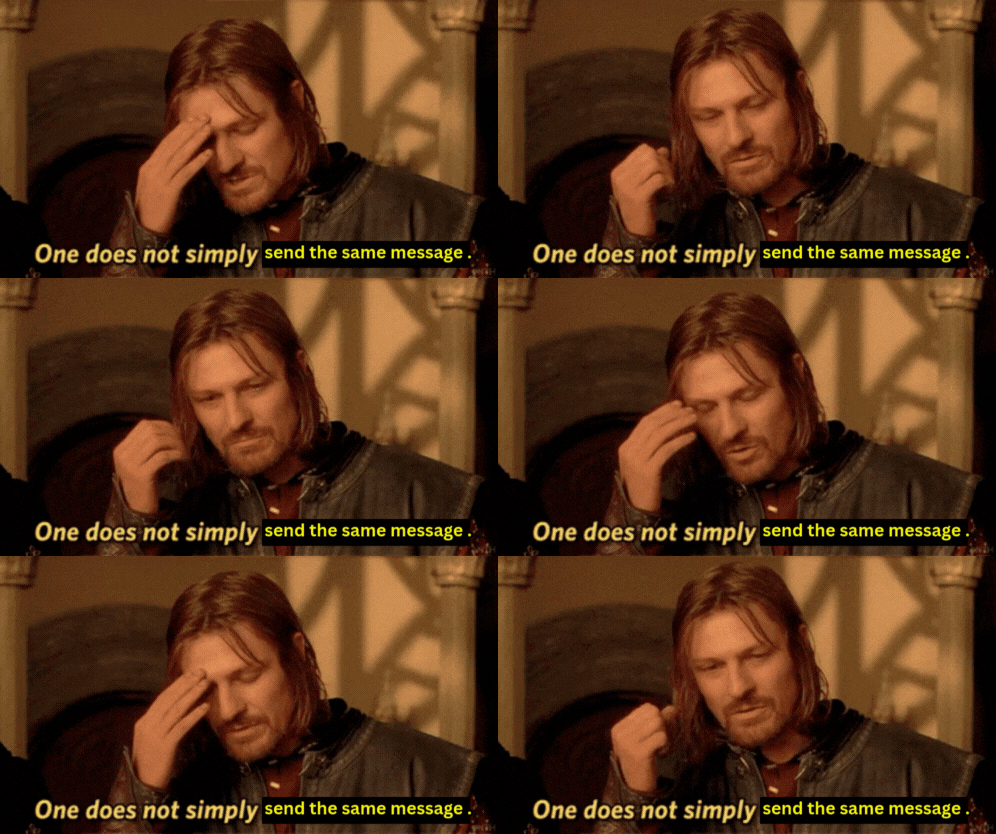
Segmentation is the foundation of a successful strategy, ensuring your messages are highly relevant.
You need to level up your audience building. Stop segmenting by location only. Use real-time behavioural data to create focused micro-segments, like users who previously ordered multiple times or cold cart abandoners. If you need to know why a user wasn't engaging early on, you have to diagnose their behaviour first. This is where the data from tools like Amplitude comes in handy.
By targeting micro-segments, you send fewer, high-impact messages. This is the difference between shouting into the void and starting a specific, profitable conversation.
How Can I Improve Customer Retention Post-Major Events?
Segmentation tells you who to message; Journeys tells you what to message, and when to send the follow-up. Journeys is OneSignal’s visual workflow builder that turns those scattered messages into a slick, strategic conversation. Think of them as PB & J of post-event retention.
- The Post-Sale Sequence: You should already be using Journeys to automate a thank-you message, a feedback request, or a prompt to use their newly acquired product.
- The Retention Loop: Journeys are essential for sustained engagement. If a user clicked your Black Friday push notification but hasn't purchased since, the Journey automatically enrols them in a new path, maybe an SMS with a specific coupon for this festive season. This orchestration is why apps using OneSignal’s Journey see 13% higher retention rates.
What is the right time to send a push notification?
Timing is everything. Even the most personalised push notification was pointless if it hit the user’s phone while they were asleep or busy.
It’s not about sending at 10 AM; it’s about event-based delivery. What your customer did in your app matters infinitely more than what time the clock says. If they completed an important trigger, like “add to cart,” that is the optimal time to message, and that specific event should power your Journey.
- Mastering the 'When': The Sweet Spot Between Useful and Annoying: Push notifications are far more personal than email; they hit the lock screen, which is precious space. You need to find that sweet spot between useful and annoying.
- Intelligent Delivery: Ideally, you want a tool that does the heavy lifting for you. Intelligent Delivery uses machine learning and historical engagement data to automatically determine the optimal send time for each individual user. It ensures your message arrives when the user is actually there and most likely to click it, not when they’re stuck in traffic.
- Frequency Capping: Even with perfect timing, you need safety measures to prevent burnout. Frequency Capping is your emergency brake. This feature allows you to define the maximum number of notifications a user can receive within a specific period (e.g., a maximum of 3 per day). This is how you prevent the "over-send" fatigue that leads to quick uninstalls during any highly competitive period, including the ongoing Festive Season.
What do you need for precise push-notification deployment?
Ideally, you want a tool that offers segmentation. We love one Signal as it can help you automate your multi-channel path with Journeys, and optimise the timing with Intelligent Delivery, you move from guesswork to a guaranteed strategy for next year.
So, What’s Next?
You can read more about OneSignal and how to use customer journeys to guide users: here. You can also chat to one of our experts, we’d be super keen to help you implement this strategic post-mortem and get your 2026 campaigns perfected 👇

Happy holidays,
The YOUKNOW Team
.png)
.png)